
There’s a particular kind of marketing report that looks brilliant at first glance.
- Website traffic is up.
- Social engagement has increased.
- Campaigns are running.
- Content is being published.
- SEO visibility is improving.
- The email calendar is full.
- Paid media is generating purchases or leads.
Everyone is certainly busy.
But then somebody (normally the marketing director or sales leader) asks the awkward question:
“What is all of this actually doing for the business?”
Silence. The marketing team know their own channels and activity like the back of their hand, but when it comes to the wider commercial picture – it’s a harder question to answer.
You might not believe it, but it’s actually a surprisingly common problem. As businesses grow, marketing often becomes more sophisticated, but also more fragmented. More channels are introduced. More specialists become involved. More platforms generate their own reports and, before long, the business has an enormous amount of marketing data without necessarily having a clear view of marketing performance.
That’s the difference between doing marketing and building a marketing function that genuinely contributes to commercial growth.
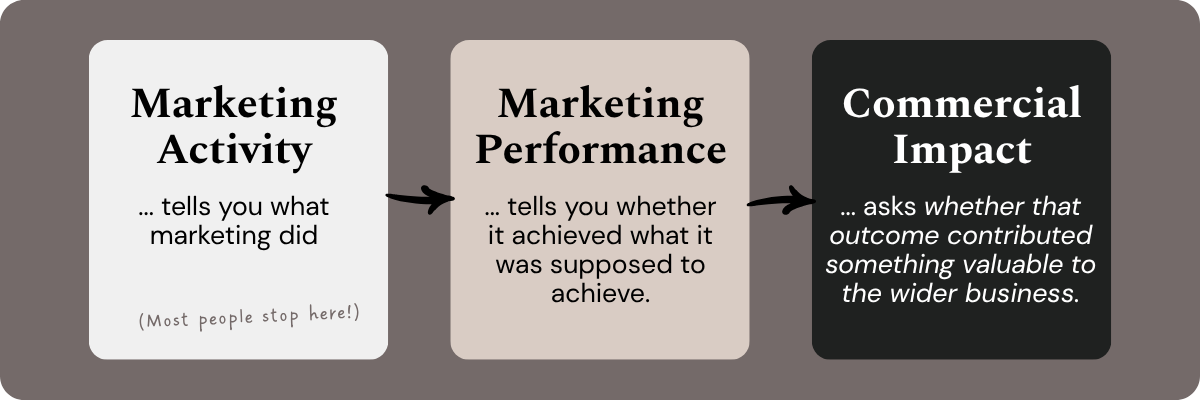
Marketing activity isn’t the same as marketing performance
Let’s start with an important distinction:
Activity tells you what marketing did.
Performance tells you whether it achieved what it was supposed to achieve.
Commercial impact goes one step further and asks whether that outcome contributed something valuable to the wider business.
Those three things aren’t interchangeable.
Imagine a business publishes eight new SEO articles. Those articles generate 10,000 organic visits and 150 enquiries.
The activity was publishing eight articles.
The marketing performance includes rankings, traffic and enquiries.
But the commercial picture needs more context. Were those enquiries from the right types of customers? How many became qualified opportunities? How many converted? What revenue and margin did they generate? Did the content influence prospects who converted through another channel? Will those rankings continue generating demand over time?
This doesn’t mean every marketing activity needs a neat revenue figure attached to it. And let’s be honest, with increasing consumer privacy rights and data protection, it’s becoming more difficult to build a full picture (even with the best attribution in the world).
It means there should be a clear line of sight between what you’re doing, why you’re doing it, what you expect it to change and how that ultimately supports the business.
That’s where marketing performance consultancy becomes valuable: not simply producing another dashboard, but helping a business understand the relationship between its marketing activity and its commercial objectives.

The measurement trap: when good numbers create false confidence
Modern marketing platforms give us access to an extraordinary amount of data. Useful, yes – but also quite dangerous. Because when something can be measured easily, it can quickly become important simply because it can be measured.
We see it all the time… take social media for example: clicks, impressions, followers, engagement, engagement rate, video views, CPC, ROAS, the list goes on…
None of these metrics are inherently bad. In the right context, they’re extremely useful indicators.
The problem starts when the metric becomes the objective.
A paid media team might reduce cost per lead while inadvertently generating poorer-quality leads. An SEO strategy could dramatically increase traffic by ranking for searches that rarely result in meaningful business. A social account could double its reach without changing brand consideration, enquiries or sales.
You can improve the number on the dashboard while making remarkably little difference to the business. It’s a trap we’ve seen in other agencies, and something we try to actively avoid at The Business Tea.
In its 2026 Go Big or Go Home research, the Institute of Practitioners in Advertising (IPA) argues that marketing effectiveness is being undermined by excessive focus on efficiency, narrow metrics and short-term measurement at the expense of broader business growth.
That distinction between efficiency and effectiveness matters.
Efficiency asks: How cheaply or quickly did we do it?
Effectiveness asks: Did it produce the outcome we actually needed?
You need both and becoming exceptionally efficient at generating something commercially unimportant isn’t much of a win.
Commercial marketing consultancy starts with the business objective
This is why we believe some of the most important marketing conversations should actually start outside the marketing department.
And no, we’re not saying that ‘everyone should be a marketer’ because that’s not true, but before discussing SEO rankings, social reach, advertising campaigns or content calendars, there are more fundamental questions to answer.
What is the business trying to achieve? Where is future growth expected to come from? Which products, services or customer groups are most commercially important? Are we trying to acquire more customers, increase customer value, improve retention, enter a new market or strengthen margins? What is currently preventing that from happening?
Only then can you ask:
What does marketing need to do to help?
That’s the principle behind commercial marketing consultancy.
Rather than starting with a channel and searching for ways to improve it, you start with the commercial objective and work backwards towards the marketing interventions most likely to influence it.
Sometimes the answer will be more investment.
Sometimes it’ll be a different channel.
Sometimes the biggest opportunity is fixing conversion rather than generating more traffic.
And sometimes the most commercially sensible recommendation is to stop doing something altogether.
Not everything that contributes to growth converts immediately
There’s an important caveat here. Commercially accountable marketing does not mean judging everything by immediate revenue.
If you do that, you’ll inevitably favour the channels and activities closest to conversion while undervaluing everything that created the demand in the first place.
Someone might discover your business through LinkedIn, watch several of your videos, see a paid advert three weeks later, search your brand on Google, read two articles and eventually submit an enquiry directly through your website.
Which channel generated the lead?
The truthful answer is that several probably contributed.
The IPA’s effectiveness research has repeatedly highlighted the importance of balancing short-term activation with longer-term brand building, rather than treating them as competing approaches.
Its 2026 analysis of more than two decades of campaign data also found that campaigns reporting very large increases in brand trust were more likely to report substantial effects across measures including customer acquisition, sales, profit and market share.
So the answer isn’t to demand an immediate ROI calculation from every social post.
It’s to understand the job each part of your marketing is supposed to do and measure it accordingly.
We’ve seen this first-hand in enterprise businesses. Paid media demonstrates an immediate return, so investment gets shifted away from brand building or organic channels where the impact takes longer to materialise. Six months later, performance starts to soften and everyone wonders why. Sustainable marketing performance rarely comes from one channel shouting the loudest. It’s about creating a consistent wall of sound across the customer journey, where the effect of each activity compounds when they’re connected.
A better marketing performance framework
Instead of putting every marketing metric into one enormous monthly report, think about performance as a chain.
Business outcome → Marketing outcome → Customer behaviour → Channel indicators → Activity
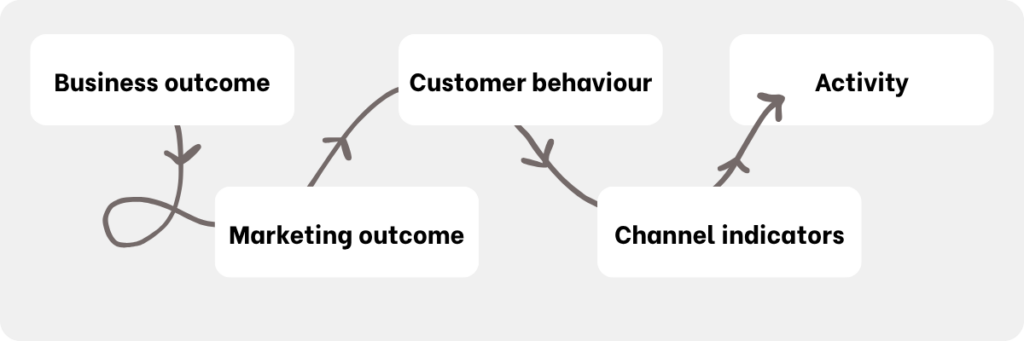
Suppose a B2B company wants to increase revenue from a particular market segment.
The commercial measure might be revenue and pipeline generated from that segment. Marketing’s outcome could be increasing qualified opportunities. Customer behaviour might include more target buyers discovering the brand, returning to the website and engaging with high-intent content. Channel indicators could then include relevant organic visibility, target-account engagement, conversion rates, cost per qualified lead and email engagement.
Suddenly, those channel metrics have context.
You haven’t stopped measuring traffic, impressions or engagement. You’ve simply stopped pretending they’re the end result.
This approach also helps leadership distinguish between leading and lagging indicators.
Revenue is usually a lagging indicator: by the time it appears, numerous things have already happened.
Search visibility, brand demand, qualified website traffic, enquiry volume, pipeline creation and conversion rates can provide earlier signals that tell you whether marketing is moving in the right direction.
Strong marketing measurement needs both.
What should you actually measure? Build a commercial marketing scorecard
So, what does this look like in practice?
The answer isn’t another dashboard containing 50 different metrics. In fact, we’d argue the opposite.
A useful marketing performance scorecard should allow somebody outside the marketing team to understand, relatively quickly, whether marketing is moving the business in the right direction.
We like to think about measurement across four layers:
| Layer | What are we trying to understand? | Example measures |
|---|---|---|
| Commercial outcomes | Is the business result changing? | Revenue, pipeline, new customers, customer lifetime value, retention, margin |
| Marketing outcomes | Is marketing creating the conditions required to achieve it? | Qualified leads, customer acquisition, demand, share of search, repeat purchases |
| Customer behaviour | Are customers behaving differently? | Conversion rate, returning visitors, branded searches, enquiry quality, purchase frequency |
| Channel indicators | Are individual channels doing their job? | Rankings, organic visibility, CPC, CTR, engagement, email clicks, landing page performance |
Not every business needs every metric in that table. But that’s the point.
If increasing recurring revenue is one of your commercial priorities, customer retention and repeat purchase behaviour probably deserve considerably more attention than Instagram follower growth. If you’re entering a new B2B market, qualified pipeline from your target audience might matter far more than overall website traffic.
The metrics you prioritise should change because the business objective changes.
A useful test is to take every KPI in your existing marketing report and ask “If this number improves, can we explain why that matters to the business?”.
If the answer is no, it doesn’t necessarily mean you should stop measuring it. But it probably shouldn’t be one of the numbers dominating the conversation with leadership or a spot on your top-level report.
It’s about trying to move away from a marketing dashboard and a commercial marketing scorecard.
When marketing optimisation services become more valuable than more activity
When growth slows, the natural response is often to add something. We’ve seen this a lot when working in larger brands…
“Launch another campaign”
“Increase advertising spend”
“Publish more content”
“Start using another platform”
But businesses don’t always have an activity problem. Sometimes they have an optimisation problem.
You could already have enough traffic but a weak conversion rate. Plenty of leads but poor qualification. Strong awareness but an unclear proposition. Effective campaigns but unreliable tracking. Multiple high-performing channels but no joined-up customer journey.
This is where marketing optimisation services should look beyond individual channel tweaks.
Optimisation can mean reallocating budget towards higher-value audiences, improving landing pages, fixing tracking, refining messaging, improving lead nurture, changing campaign objectives or identifying where prospects disappear between marketing and sales.
The question changes from “What else could we do?” to “How do we get more commercial value from what we’re already doing?”. For many established marketing teams, that’s a much more valuable conversation.
Before adding more marketing, find where growth is leaking
When performance isn’t where you want it to be, try resisting the temptation to immediately ask “what marketing should we add?”
Instead, work through the commercial journey and find the constraint.
Not enough of the right people know you exist?
You may have a demand or awareness problem. Brand building, SEO, paid media, partnerships or broader distribution could be the priority.
You’re attracting plenty of people, but not the right ones?
You may have a targeting or positioning problem. More traffic will simply give you more of the wrong traffic.
The right people are arriving but not enquiring or purchasing?
Look at your proposition, website experience, messaging, pricing, conversion journey and calls to action before spending more money getting people there.
You’re generating enquiries but they’re not becoming customers?
The problem might sit between marketing and sales: lead quality, qualification, response times, sales enablement or the handover process.
You’re acquiring customers but growth is still difficult?
Look further down the funnel. Retention, repeat purchase rate, customer value, margin or churn could be limiting growth far more than customer acquisition.
This is why diagnosing marketing performance at a channel level alone can be misleading.
If your conversion problem sits on the website, doubling paid media spend doesn’t fix it. It simply pays to send twice as many people into the same problem.
Likewise, if customers aren’t staying, continually increasing acquisition can hide a retention problem rather than solve it.
Before investing in more, identify the constraint that’s preventing your existing marketing from creating more commercial value.

A five-minute marketing performance audit
While we offer consultancy at The Business Tea, you don’t need a six-week consultancy project to start asking better questions about marketing performance today.
If your marketing function feels busy but you’re unsure how much it’s contributing, take five minutes and answer the following honestly….
- Can we clearly explain which business objective each major marketing activity supports?
- Do our reports show business and customer outcomes as well as channel metrics?
- Do we understand the quality and commercial value of the leads or sales we’re generating, not simply the volume?
- Are we balancing short-term performance with the activity required to create future demand?
- When something performs well or badly, do we actually change what we do next?
That final question is particularly important. Measurement without decision-making is just reporting.
The purpose of marketing data isn’t to create a prettier dashboard. It’s to help you make better decisions about where to invest, what to change, what to scale and what to stop.
If you struggled to answer two or more of these questions, the issue may not be that your marketing isn’t performing. The first problem is that you don’t yet have enough visibility to know whether it is.
Your marketing doesn’t need to be busier. It needs to be more useful.
A high-performing marketing function won’t always be the one publishing the most content, running the most campaigns or appearing on the most channels.
It will be the one that understands why it’s doing those things.
Good marketing should create demand, influence customers, generate opportunities, strengthen the brand and ultimately help the business achieve its commercial objectives. That requires strategy, execution and measurement to work together.
At The Business Tea, that’s how we approach marketing. We work with businesses and internal marketing teams to understand the commercial problem first, then determine where strategy, channels, measurement and execution need to change. After all, you wouldn’t go to the doctor and receive a prescription before having a formal diagnosis, so why would you do that with your marketing?
Whether that means independent marketing performance consultancy, broader commercial marketing consultancy or hands-on marketing optimisation services, the objective isn’t to give you more marketing activity to manage. It’s to make the marketing you’re investing in work harder for the business.

Work with The Business Tea
If you’re stuck in a bit of a rut with your marketing, we would love to hear from you. Click here to send us a message and we’ll see how best we can help you.
Likewise, if you’re not quite ready to work with us directly, we share practical insights on marketing strategy, as well as channel specific content such as SEO, paid media, social media and analytics over on our socials.
Frequently Asked Questions
What is marketing performance?
Marketing performance is the measurement of how effectively marketing activity contributes towards defined marketing and business objectives. Rather than looking only at channel metrics such as traffic, clicks, impressions or engagement, marketing performance considers whether that activity is creating meaningful outcomes such as qualified demand, customers, revenue, retention or long-term brand growth.
The metrics used to assess performance will therefore differ depending on what the business is trying to achieve.
How do you measure marketing’s contribution to business growth?
Start with the business objective and work backwards. Define the commercial outcome the business needs, the marketing outcomes that could influence it, the customer behaviours that need to change and finally the channel metrics that indicate whether those changes are happening.
For example, if the objective is B2B revenue growth, useful measures could include qualified pipeline, lead-to-opportunity conversion, target-market website engagement, customer acquisition cost and revenue generated from new customers.
The important thing is establishing a clear connection between marketing activity and the commercial outcome rather than relying on one metric in isolation.
What is the difference between marketing efficiency and marketing effectiveness?
Marketing efficiency measures how economically resources are being used, while marketing effectiveness considers whether marketing is achieving the desired outcome.
For example, reducing cost per lead would indicate improved efficiency. However, if those cheaper leads are less likely to become customers, the campaign may not have become more effective.
Strong marketing performance requires both: spending resources efficiently while ensuring the activity contributes towards the outcomes that matter to the business.
Which marketing metrics matter most to senior leadership?
Senior leadership will typically need greater visibility of commercial outcomes than individual channel metrics. Depending on the business, these could include revenue influenced by marketing, qualified pipeline, customer acquisition cost, customer lifetime value, conversion rates, retention, market share and marketing investment.
Channel-level measures such as rankings, impressions, clicks and engagement still matter, but they are most useful when their relationship with wider marketing and commercial objectives is understood.
How can you tell if your marketing is actually working?
Start by asking whether marketing is achieving the outcome it was designed to influence.
Increasing website traffic doesn’t necessarily mean marketing is working if the objective is to generate qualified sales opportunities. Likewise, a social campaign shouldn’t automatically be considered unsuccessful because it hasn’t generated immediate revenue if its purpose is to increase awareness amongst a strategically important audience.
Good marketing measurement therefore requires clearly defined objectives, relevant leading and lagging indicators, reliable tracking and regular evaluation of whether marketing activity is changing the customer or commercial outcomes that matter.
What are leading and lagging indicators in marketing?
Leading indicators are measures that can provide an early signal of future performance, while lagging indicators confirm outcomes that have already happened.
Search visibility, qualified website traffic, branded search demand, enquiry volume and pipeline creation can all act as leading indicators depending on the strategy. Revenue, profit, completed sales and customer retention are typically lagging indicators.
Businesses should monitor both. Leading indicators help marketing teams adjust activity earlier, while lagging indicators help determine whether that activity ultimately contributed towards the intended commercial result.
What does a marketing performance consultancy do?
A marketing performance consultancy helps businesses understand how effectively their marketing activity supports wider commercial objectives and where performance could be improved.
This can involve reviewing marketing strategy, channel performance, measurement and attribution, customer journeys, budgets, conversion performance and the relationship between marketing and sales.
Rather than simply recommending more marketing activity, effective marketing performance consultancy should help identify where growth is being constrained and where changes could create greater commercial value.
When should a business consider marketing optimisation services?
Marketing optimisation services can be particularly valuable when a business is already investing significantly in marketing but isn’t confident that investment is producing the best possible commercial return.
Common signs include increasing traffic without increasing conversions, high lead volumes but poor lead quality, rising acquisition costs, fragmented channel activity, unreliable measurement, weak conversion rates or uncertainty about where marketing budget should be allocated.
In these situations, the priority may not be doing more marketing. It may be improving how existing strategy, channels, customer journeys and investment work together.