
There is rarely a shortage of things a marketing team could be doing.
SEO. Paid advertising. Social media. Email marketing. Events. Content. CRM. Website optimisation. Brand campaigns. Partnerships. Influencer marketing. The list goes on.
The real question is: what should you actually be doing?
Good marketing planning isn’t about filling a calendar with activity. It is about understanding what the business needs to achieve, determining how marketing can meaningfully contribute to those objectives, and turning that into a clear set of priorities.
We’ve worked through this internally, and with our clients countless times over the last decade. Without it, a marketing plan can quickly become a shopping list of tactics. With it, you can build a marketing roadmap that gives your team clarity on what you’re doing, why you’re doing it and how you’ll know whether it’s working.
Contents:
- What is marketing planning?
- Why marketing planning should start with business objectives
- How to create an effective marketing roadmap
- Step 1: Get clear on business objectives
- Step 2: Turn business objectives into marketing objectives
- Step 3: Understand your starting position
- Step 4: Decide your marketing priorities
- Step 5: Balance short-term and long-term marketing priorities
- Step 6: Make sure your marketing priorities are actually achievable
- Step 7: Put your marketing priorities in the right order
- Step 8: Build your marketing roadmap
- Step 9: Give every priority a measure of success
- Step 10: Get the right people aligned around your marketing roadmap
- Step 11: Build a marketing roadmap for when things don’t go to plan
- Step 12: Review your marketing roadmap without constantly rewriting it
- Your marketing roadmap should create clarity, not more work
- Marketing roadmap planning checklist
- Need help turning your business objectives into a marketing strategy?
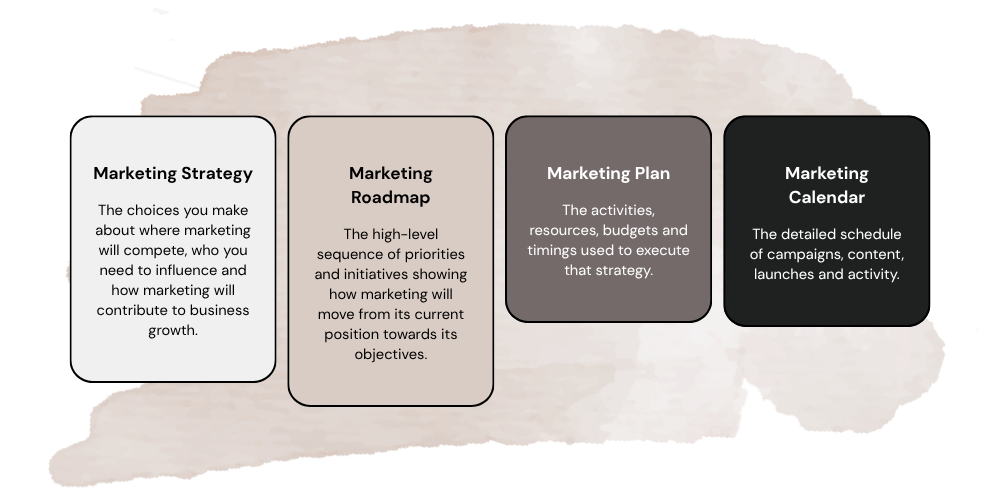
Before we get into it, it’s worth clarifying a few terms that are often used interchangeably in marketing but actually mean different things:
Marketing strategy: The choices you make about where marketing will compete, who you need to influence and how marketing will contribute to business growth.
Marketing plan: The activities, resources, budgets and timings used to execute that strategy.
Marketing roadmap: The high-level sequence of priorities and initiatives showing how marketing will move from its current position towards its objectives.
Marketing calendar: The detailed schedule of campaigns, content, launches and activity.
What is marketing planning?
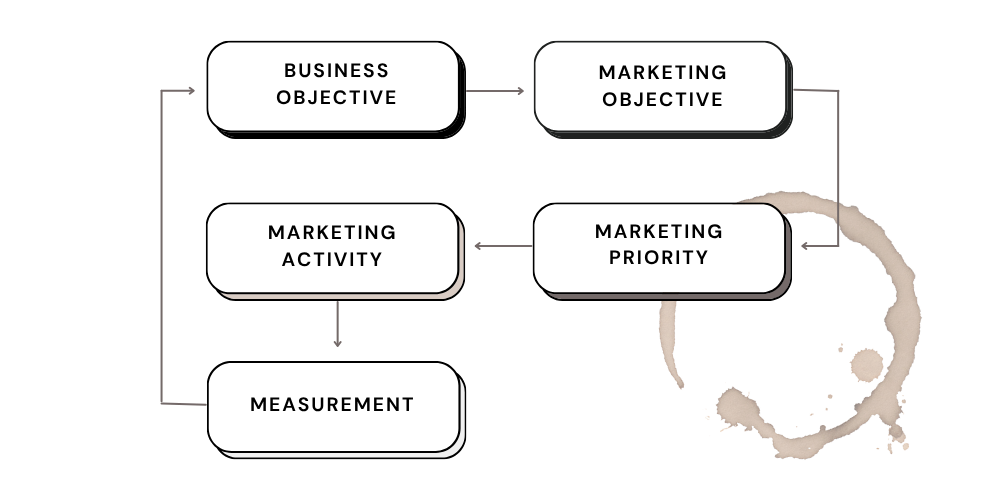
Marketing planning is the process of translating wider business objectives into marketing objectives, priorities, activity and measures of success. In simple terms, it connects Business objective → Marketing objective → Strategic priority → Activity → Measurement.
For example, imagine the business has set an objective to increase annual revenue by 20%. Simply saying “marketing needs to generate more leads” isn’t really a plan. Effective marketing planning requires you to go further.
Where will that additional revenue come from? New customers? Existing customers? New markets? A particular product or service? Increased order values? Improved retention?
Only when you understand the commercial objective properly can you determine what marketing needs to influence.
That might mean increasing qualified demand, improving conversion rates, entering a new market or increasing repeat purchases. Those become the foundations of your marketing priorities. And that’s considerably more useful than deciding you need to “post more on LinkedIn”.
Why marketing planning should start with business objectives
One of the easiest traps in marketing is starting with channels. “We need to improve our SEO.”, “We should be doing more on TikTok.”, “Our competitors are running LinkedIn Ads.”… perhaps you should. But none of those statements tells us what problem you’re actually trying to solve.
Research from Gartner has highlighted this exact issue. Its analysis found that, without agreement on the business priorities marketing should support, strategic plans can become little more than lengthy to-do lists containing marketing tactics without a clear connection between them.
That creates activity, but not necessarily impact.
The Institute of Practitioners in Advertising (IPA) defines marketing effectiveness as the process of improving business performance through marketing activity. That’s an important distinction: marketing performance and business performance aren’t automatically the same thing.
Your website traffic could increase while revenue falls. Your social engagement could improve without generating a single meaningful commercial opportunity. Your cost per lead could fall while the quality of those leads gets considerably worse.
Good marketing planning therefore starts by asking:
What does the business need to achieve, and what needs to change for marketing to help make that happen?
From there, your marketing roadmap becomes much clearer.

How to create an effective marketing roadmap
Step 1: Get clear on the business objectives
Before discussing campaigns or channels, get specific about the commercial destination. “Grow the business” isn’t specific enough.
Instead, objectives might include:
- increase revenue from £5 million to £6 million
- enter two new geographical markets
- increase customer retention by 10%
- generate £1 million in revenue from a new product
- increase average customer value
- reduce reliance on one major customer segment
The numbers won’t always be this neat, but the principle remains the same.
You need enough clarity to understand what marketing is being asked to contribute towards. It is also worth understanding why the objective exists.
If the business wants more customers because retention is poor, acquiring more customers might temporarily disguise the real problem rather than solve it.
Sometimes the best marketing planning starts with challenging the objective itself. Which is why it’s incredibly important to have open and honest conversations with leadership teams (especially commercial teams and cross-functional leaders in your organisation) to really dig deep and understand what is being asked of the marketing team and why.
Questions to ask before building your marketing plan
To help give you an idea of the things we would ask when working with leadership putting together a marketing roadmap, we wanted to give you some example questions to probe deeper. When somebody tells you the business objective is “grow revenue by 20%”, try asking things like:
- Where is that growth expected to come from?
- Which products, services or customer segments are strategic priorities?
- Is the expectation acquisition, retention, expansion or a mixture?
- Are there particular markets or geographies we’re entering?
- What margin expectations sit behind the revenue target?
- What operational capacity exists to service additional demand?
- Are there sales targets already attached to the objective?
- What assumptions have been made about marketing’s contribution?
- What must be true for this objective to be achievable?
- What are the biggest commercial risks?
What we’re getting at here, and the bottom line is: marketing shouldn’t blindly receive a business objective and disappear into a room to make a plan.
Step 2: Turn business objectives into marketing objectives
Next, identify what marketing needs to influence. Let’s take a simplified example.
Business objective: Generate an additional £1 million in annual revenue.
That could translate into several potential marketing objectives:
Marketing objective 1: Increase qualified opportunities entering the sales pipeline.
Marketing objective 2: Increase conversion from marketing-qualified lead to sales opportunity.
Marketing objective 3: Increase awareness amongst a new target customer segment.
Marketing objective 4: Generate greater revenue from existing customers.
Notice that none of these mentions a channel yet. You are defining the job marketing needs to do before deciding how it should do it.
A worked marketing planning example: from business objective to marketing priorities
It’s easy enough to explain this in theory. So, let’s put some numbers against it and show you what this might actually look like in practice.
Imagine you’re the Head of Marketing for a B2B services business currently generating £8 million in annual revenue. The leadership team has set an objective to grow this to £10 million over the next financial year.
Your first instinct might be to take the additional £2 million target back to your marketing team and start discussing how you’re going to generate more leads. Don’t. At least, not yet.
The first question is where is that additional £2 million expected to come from?
After speaking with the leadership, sales and finance teams, you establish that the commercial plan looks something like this:
- £1.2 million from acquiring new customers
- £500,000 from increasing revenue from existing customers
- £300,000 from a newly launched service
Immediately, “grow revenue by £2 million” has become much more useful. Now we can start working backwards.
Objective 1: Generate £1.2 million from new customers
Let’s assume an average new customer is worth approximately £30,000 in first-year revenue. That means the business needs around 40 additional customers to generate £1.2 million.
But marketing can’t simply set an objective to “generate 40 customers”. We need to understand what needs to happen further up the funnel.
If sales historically closes around 25% of qualified opportunities, the business would need approximately 160 qualified sales opportunities to generate those 40 customers.
Now we have something marketing can influence. Rather than:
Business objective: Grow revenue.
We have:
Business objective: Generate £1.2 million in additional new-customer revenue.
Commercial requirement: Acquire approximately 40 additional customers worth an average £30,000 each.
Marketing objective: Generate sufficient qualified demand to support approximately 160 additional sales opportunities.
Marketing priority: Increase qualified demand amongst the company’s ideal customer profile.
Only now should we start asking which marketing activity might achieve that.
Depending on what our research and existing performance data tells us, that could eventually lead to priorities around search visibility, thought leadership, paid media, events, account-based marketing, partnerships or conversion optimisation.
The channel comes last, not first. Something that we LIVE by at The Business Tea.
Objective 2: Generate £500,000 more from existing customers
This requires a completely different marketing response.
After looking at the customer base, we discover that a significant proportion of existing customers only buy one of the company’s services, despite several complementary services being available. Suddenly, spending more money acquiring new customers isn’t necessarily the only (or even the best) answer.
Our planning chain might instead look like:
Business objective: Generate £500,000 in additional existing-customer revenue.
Commercial requirement: Increase cross-sell and expansion within the existing customer base.
Marketing objective: Increase awareness and uptake of relevant additional services amongst current customers.
Marketing priority: Improve customer marketing and cross-sell activity.
Potential initiatives: Customer segmentation, CRM nurture programmes, account-specific campaigns, customer education and sales enablement.
Measure of success: Expansion pipeline, cross-sell rate and revenue generated from existing customers.
That’s still marketing contributing towards growth – we’re simply influencing a different commercial lever.
Objective 3: Generate £300,000 from a new service
Finally, the business wants its newly launched service to contribute £300,000.
This creates another set of questions.
Does the existing customer base understand the new proposition? Is there established demand for it? Do potential customers associate the business with this service? Does the sales team know how to sell it? Is the proposition differentiated enough from competitors?
Our marketing priority might therefore be less about immediately generating leads and more about successfully establishing the proposition within the market.
That could give us:
Business objective: Generate £300,000 from the new service.
Commercial requirement: Establish a viable pipeline for the new proposition.
Marketing objective: Build awareness, consideration and demand amongst relevant existing and prospective customers.
Marketing priority: Establish the positioning and go-to-market approach for the new service.
Potential initiatives: Proposition development, customer research, sales enablement, launch content, PR, paid media and targeted demand generation.
Measure of success: Awareness within the target audience, qualified pipeline and ultimately revenue attributed to the new service.
Put all three together and our marketing planning starts to look considerably more strategic:
| Business Objective | Commercial Requirement | Marketing Objective | Marketing Priority | Example Initatives | Primary Measure |
|---|---|---|---|---|---|
| Generate £1.2m in new-customer revenue | Acquire ~40 customers | Generate sufficient qualified demand | Increase demand amongst the ideal customer profile | Search, thought leadership, paid media, conversion optimisation | Qualified pipeline |
| Generate £500k from existing customers | Increase cross-sell and expansion | Increase uptake of additional services | Improve customer marketing | CRM segmentation, nurture, customer campaigns | Expansion revenue |
| Generate £300k from a new service | Establish a viable pipeline | Build awareness, consideration and demand | Establish the new proposition in-market | Positioning, content, PR, paid media, sales enablement | New service pipeline and revenue |
And that is the difference between receiving a £2 million growth target and immediately asking your team: “Right, what campaigns can we run?”
Instead, we’ve broken the business objective down into its underlying commercial requirements, identified what marketing actually needs to influence and established several clear marketing priorities.
We still haven’t built our final marketing roadmap. Nor have we decided exactly which channels deserve investment. That’s intentional.
Before we do either of those things, we need to understand our starting position, because our assumptions about how we’ll achieve these objectives need to be tested against the data.
Step 3: Understand your starting position
You now know where you’re going. Next, you need to know where you’re starting from.
This is where data becomes particularly useful.
Look across the customer journey and ask questions such as:
- Where does demand currently come from?
- Which channels generate your best customers?
- Where are prospects dropping out of the funnel?
- Which products or services generate the greatest value?
- What is your customer acquisition cost?
- What percentage of customers purchase again?
- Which customer segments are most profitable?
- Where are competitors outperforming you?
- Where does your brand lack awareness or consideration?
The objective isn’t to collect every metric available. Trust us, we’ve fallen into this trap ourselves on numerous occasions, particularly within larger organisations.
The goal is to identify the barriers standing between where the business is now and where it wants to be. That’s the gap your marketing roadmap needs to address.
One thing we would say here is that normally this level of data requires some support from other teams. Perhaps finance, IT, operations – whoever it is that you need the data from, the challenge is ensuring they understand why you need it, and the value this will bring the business.
If you have a marketing analyst team you can turn to, congratulations. If you’re like 99% of the other businesses out there, you probably don’t. We recommend jumping on a quick call where possible, don’t just fire an email with a list of data points you need because they won’t understand the importance of why and what you’re asking of them.

Step 4: Decide your marketing priorities
This is where strategic marketing planning really earns its keep. You’ve probably uncovered ten, twenty or fifty things you could improve. You cannot realistically prioritise all of them.
At The Business Tea, we’re big believers that a strategy should tell you what not to do as much as what to do. There are tonnes of frameworks out there you can follow to prioritise your work (such as RICE scoring, etc), but to boil it down to its simplest form: for each potential priority, consider four things…
Impact: If we improve this, how much could it contribute towards the business objective?
Evidence: What data or insight suggests this is genuinely a problem or opportunity?
Resource: What budget, expertise and capacity would it require?
Timescale: How quickly could it realistically make an impact?
This prevents the loudest idea in the room automatically becoming the next marketing campaign or focus. It also helps teams avoid chasing whatever happens to be fashionable that month.
From our experience, it also helps defend marketing’s time and focus. There’s nothing worse than the latest “I’ve had an idea…” message landing from leadership with an expectation that everything else gets dropped immediately. It becomes much easier to defend your priorities when they’re backed by agreed objectives and evidence rather than personal preference.
Step 5: Balance short-term and long-term marketing priorities
Not every marketing priority should generate an immediate return. If every marketing problem could be solved with a quick-win campaign, we’d eventually ‘finish’ marketing altogether. Unfortunately (or fortunately for those of us employed to do it) businesses, markets and customers don’t stand still. Some activity exists to capture demand that already exists. Other activity helps create future demand. You need both.
We’ve seen it many times before (again, especially in growing organisations) where they’re so focused on acquisition, that they aren’t spotting opportunities elsewhere – or worse, things start to crumble when they’re not looking at them.
The IPA’s influential The Long and the Short of It research by Les Binet and Peter Field examined the tension between short-term sales activation and long-term brand building. Its wider effectiveness research continues to emphasise the importance of balancing immediate results with sustainable growth.
More recently, the IPA’s 2026 Go Big or Go Home report warned against focusing too heavily on efficiency and short-term metrics at the expense of broader business outcomes including market share, margins and profit.
This is important when building your marketing roadmap. If every priority needs to produce revenue next Tuesday, activity can become increasingly concentrated around the small proportion of customers already close to purchasing.
Conversely, if everything is focused on long-term brand building, you might struggle to generate the pipeline the business needs today.
Effective marketing planning considers both horizons.
Step 6: Make sure your marketing priorities are actually achievable
By this point, you should have a much clearer idea of what marketing should prioritise. Now comes the slightly less exciting question: can you actually deliver it?
A marketing roadmap that requires three new hires, a £300,000 media budget, a new website, a CRM implementation and 150 pieces of content isn’t particularly useful if you’ve got two marketers and £80,000 to spend.
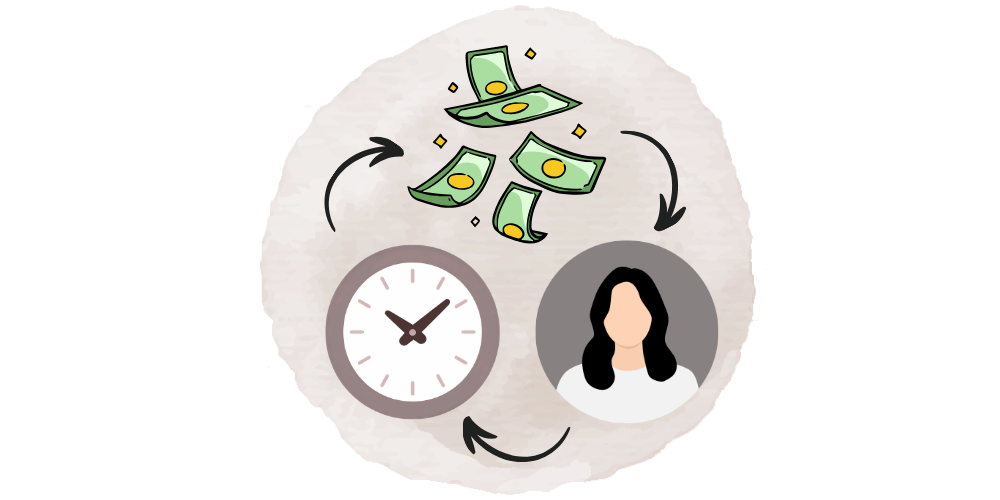
Every marketing priority consumes three things:
Money: What budget will it require, including media, technology, agencies, freelancers, production and any other external costs?
People: Who actually has the expertise and capacity to deliver it? Do those capabilities exist internally, or will you need additional support?
Time: How long will it realistically take – not only to execute, but to start generating meaningful results?
This is where marketing planning sometimes requires another uncomfortable conversation with leadership.
If the business expects marketing to deliver significantly more without increasing budget or resource, something has to give. Your job isn’t to magically squeeze another 30 hours into everyone’s working week. It’s to explain the trade-offs clearly.
For every major priority on your marketing roadmap, ask:
- What will this realistically cost?
- Who needs to deliver it?
- Do we have that capability internally?
- What other teams or suppliers will we depend on?
- How much internal capacity will it consume?
- What are we prepared to stop doing to make room for it?
That final question is arguably the most important. Adding something to your marketing roadmap without removing or deprioritising anything else isn’t prioritisation. It’s just giving your team more work.
We’d recommend categorising resource requirements against each priority as existing capacity, additional investment required or currently unresourced. That gives leadership a much more transparent view of what can be achieved with the resources available.
It also turns budget conversations into commercial decisions. Rather than saying “marketing needs another £50,000”, you’re able to say:
“Priority A supports this business objective and requires £50,000 of additional investment. Without it, we either need to reduce the expected outcome, delay the initiative or deprioritise something else.” That’s a much stronger conversation to have.
Step 7: Put your marketing priorities in the right order
Knowing what to prioritise is only half the battle. You also need to work out what needs to happen first.
From our experience, marketing initiatives are never isolated. One piece of work often creates the foundation another depends on.
For example:
- scaling paid media before fixing broken conversion tracking makes it harder to understand what’s actually working
- producing dozens of SEO articles while significant technical SEO issues prevent search engines properly accessing your website is unlikely to be the best use of resource
- building sophisticated CRM nurture programmes before fixing customer segmentation can simply automate the wrong message more efficiently
- investing heavily in promoting a new service before establishing its positioning risks spending money sending more people towards a proposition that doesn’t resonate
In other words, priority doesn’t automatically mean “do it immediately”.
Some strategically important initiatives need to wait because something else needs to happen first. A simple way to think about sequencing your marketing roadmap is: Foundation → Build → Scale
Foundation: Get the fundamentals right. This might include measurement, customer research, positioning, technical infrastructure, CRM, tracking or resolving significant website issues.
Build: Create the assets and capabilities needed to execute the strategy. This might include website improvements, content, landing pages, campaigns, nurture programmes or sales enablement.
Scale: Increase investment behind the things you’ve established and validated. This might include greater media spend, content expansion, automation, new channels or entering additional markets.
This doesn’t mean every marketing roadmap needs to follow exactly the same sequence. The point is to identify dependencies before committing to timings.
For every major initiative, ask:
What needs to be true before we can do this properly?
That one question can save a huge amount of wasted budget and effort.
It also gives marketing leaders a much better way to explain sequencing to stakeholders. Rather than saying “we can’t do that yet”, you can explain:
“We absolutely want to do that. But Initiative B depends on Initiative A being completed first. If we skip that foundation, we’re increasing the risk that the investment doesn’t deliver what we need it to.”
That’s not marketing putting up barriers. That’s good marketing planning.
Step 8: Build your marketing roadmap
Now we’re ready to turn the strategy into action. A good marketing roadmap doesn’t need to contain every task your marketing team will complete over the next 12 months.
Instead, it should show the major priorities, initiatives, dependencies and expected outcomes.
Your roadmap should remain high-level enough to be understood by stakeholders who don’t need the day-to-day detail. Here’s an example:
| Period | Priority | Key Initative | Intended Outcome |
|---|---|---|---|
| Q1 | Improve measurement | Fix CRM and marketing attribution | Establish reliable performance baseline |
| Q1 – Q2 | Increase search visibility | Technical SEO and content programme | Increase relevant organic demand |
| Q2 | Improve conversion | Website and landing page optimisation | Increase enquiry conversion rate |
| Q2 – Q3 | Build category awareness | Brand and content campaign | Increase awareness among target buyers |
| Q3 – Q4 | Increase qualified pipeline | Paid media activation | Generate incremental sales opportunities |
Notice how the roadmap isn’t simply:
January: SEO
February: Social media
March: Email
Instead, every initiative has a reason to exist. That’s the difference between a marketing calendar and a marketing roadmap.
Step 9: Give every priority a measure of success
Finally, decide how you’ll know whether the plan is working. Avoid relying entirely on channel-level metrics. Impressions, rankings, clicks, engagement and website sessions can all provide useful diagnostic information, but your measurement framework should eventually connect marketing activity back to the outcomes the business actually cares about.
Depending on your objectives, those might include:
- qualified leads
- pipeline generated
- customer acquisition cost
- conversion rate
- revenue
- customer lifetime value
- retention
- market share
- profitability
Use leading and lagging indicators to measure progress
There’s another important distinction to make here: the metric that tells you you’re making progress isn’t always the same metric that tells you you’ve ultimately succeeded.
This is where leading and lagging indicators become useful.
Leading indicators give you an earlier indication of whether your marketing activity is moving in the right direction. They tend to change before the final commercial outcome occurs.
Depending on your objective, these might include:
- visibility amongst your target audience
- relevant organic search traffic
- target-account engagement
- landing page conversion rate
- qualified enquiries
- marketing-generated opportunities
- pipeline value
- customer engagement
- repeat purchase intent
Lagging indicators tell you whether the desired business outcome ultimately happened. These typically take longer to materialise and might include:
- revenue
- profitability
- customer acquisition cost
- customer lifetime value
- retention
- market share
- revenue from a new product or service
Neither is inherently better than the other. You need both. Let’s go back to our fictional B2B business from earlier.
Remember that marketing needed to help generate approximately 160 qualified opportunities to support the acquisition of 40 new customers and £1.2 million in new-customer revenue.
We wouldn’t wait until the end of the financial year, look at revenue and then decide whether marketing worked.
We might monitor:
Early indicators: Target audience reach, relevant search visibility and qualified website traffic.
Mid-funnel indicators: Enquiry volume, enquiry quality and conversion to qualified opportunity.
Commercial indicators: Pipeline generated, customers acquired and ultimately new-customer revenue.
This creates a chain of evidence between marketing activity and business performance.
It also helps you diagnose problems much earlier.
If visibility is increasing but qualified enquiries aren’t, perhaps your proposition or conversion journey needs attention. If opportunities are increasing but customers aren’t, perhaps the problem sits further down the sales process. If customers are increasing but profitability isn’t, you may have a completely different commercial issue.
The point isn’t to create hundreds of KPIs. Quite the opposite.
Choose a small number of measures that tell you whether you’re moving in the right direction now, and whether you ultimately arrived where the business needed to go.
The metrics you choose should reflect the job each marketing activity is supposed to perform. And remember (we’re going to repeat louder for the people at the back or who skim-read earlier) not every measure needs to move immediately.
Some marketing effects take considerably longer to materialise, which is another reason your marketing roadmap should include short, medium and long-term measures.
It’s also a good idea to communicate this clearly to any stakeholders involved. This will prevent your finance director from saying things like “You’ve invested in SEO which has cost us a big chunk of money, why aren’t we seeing returns yet?” – and can also help you preserve budget that has been spent, but not yet shown any return on investment.
Step 10: Get the right people aligned around your marketing roadmap
A marketing roadmap might be owned by marketing, but it shouldn’t be created in a marketing echo chamber.
Many of the assumptions, dependencies and outcomes within your plan will involve other areas of the business. If those teams only see the finished roadmap once you’ve built it, you risk discovering fairly late in the process that sales disagrees with your pipeline assumptions, finance hasn’t budgeted for the investment or operations doesn’t have capacity to support the growth you’re planning to generate. Not ideal.
Who needs to be involved will depend on your organisation, but typically we’d expect input from:
Leadership: To establish the wider business objectives, strategic direction and expectations of marketing.
Finance: To validate revenue assumptions, margins, budgets, investment levels and commercial measures of success.
Sales: To understand pipeline requirements, conversion rates, customer objections, lead quality and where marketing can best support commercial activity.
Customer service or account management: To understand retention, customer sentiment, recurring problems and opportunities to increase customer value.
Product or operations: To understand upcoming launches, operational or technical capacity, delivery constraints and whether the business can actually service the demand marketing is being asked to create.
Marketing: To bring together customer, competitor, market and performance insight and translate all of the above into a coherent marketing strategy.

This doesn’t mean marketing planning needs to become a six-week committee meeting where everyone gets to choose their favourite campaign.
Marketing should still own the marketing strategy.
The purpose of stakeholder involvement is to make sure the inputs and assumptions are correct and that everybody understands the role marketing will play in achieving the wider business objectives.
Before finalising your roadmap, we’d recommend getting explicit agreement around four things:
- What marketing is being asked to achieve
- What marketing is prioritising to achieve it
- What resources and dependencies those priorities require
- How success will be measured
If everyone agrees to those four things at the beginning, conversations become considerably easier later. Especially when somebody asks why their spontaneous “we should launch a podcast” idea isn’t suddenly at the top of your priority list.
Step 11: Build a marketing roadmap for when things don’t go to plan
We’re about to say something incredibly obvious: your marketing plan will change.
Budgets get cut. Competitors move. New products get delayed. Sales targets change. Campaigns underperform. Campaigns unexpectedly overperform. New technology appears. Leadership priorities shift.
That’s normal.
The mistake is building a marketing roadmap that assumes the next 12 months will unfold exactly as predicted. Instead, build enough flexibility into your marketing planning to understand what you’ll do when circumstances change.
You don’t need dozens of complicated financial models. For most marketing teams, three simple scenarios are enough:
Base case: The plan you currently expect to deliver based on the agreed budget, resources and assumptions.
Upside case: What happens if performance exceeds expectations or additional investment becomes available? Where would you confidently invest more? (This is particularly useful when additional budget unexpectedly becomes available: instead of scrambling for somewhere to spend it, you’ve already identified where incremental investment could have the greatest impact).
Downside case: What happens if budget, resource or expected performance falls below plan? What would you protect, reduce, delay or stop?
A useful exercise for any marketing leader is to ask:
- If I lost 20% of my budget tomorrow, what would I protect?
- If I gained another 20%, where would I invest it?
- Which priorities are absolutely critical to the business objective?
- Which initiatives could be delayed without significantly affecting the outcome?
- What would cause us to stop an initiative entirely?
- If our biggest growth assumption proves wrong, what would we do instead?
If those questions are impossible to answer, your priorities probably aren’t quite clear enough yet.
You can also establish decision triggers in advance. For example:
“If qualified pipeline from paid search remains below £X after three months, we’ll review the channel’s role and reallocate budget if necessary.” or, “If conversion improves beyond X%, we’ll release additional budget to scale acquisition.”
This is considerably better than making those decisions reactively when everybody is under pressure.
Scenario planning doesn’t mean expecting your strategy to fail. It means accepting that a good marketing roadmap should guide decision-making when reality inevitably differs from the spreadsheet.
Step 12: Review your marketing roadmap without constantly rewriting it
Once the marketing roadmap is agreed, somebody needs to make sure it remains useful. As you’re reading this, you’re probably that person.
That means establishing a simple governance rhythm. The important word there is rhythm.
You don’t want to create a strategy in January, put it into a presentation and rediscover it eleven months later. But you also don’t want to rewrite your entire marketing strategy every time a campaign has a bad week.
We’d recommend reviewing your marketing plan at three different levels:
Monthly: Review performance and delivery
Look at whether activity is progressing as expected, review your leading indicators, identify immediate blockers and make tactical optimisations where necessary.
The question here is: are we executing the plan effectively?
Quarterly: Review priorities and assumptions
Take a broader view. Are the priorities still right? Have important assumptions changed? Is performance supporting the original strategy? Do resources need reallocating? Have new opportunities or risks emerged?
The question becomes: is this still the right plan?
Annually: Review strategic direction
Return to the beginning of the process. Review the wider business objectives, commercial requirements, market conditions, customer needs and marketing’s role in supporting the next stage of the business.
Here, you’re asking: what does the business need marketing to achieve next?
A poor month doesn’t necessarily mean your strategy is wrong. Equally, stubbornly following a 12-month roadmap when the evidence tells you the assumptions behind it have fundamentally changed isn’t discipline. It’s just refusing to adapt.
We’d also recommend assigning an owner to every strategic priority and establishing how decisions to change the roadmap will be made. If you’re a head of marketing or marketing director you may well have people in your team that things naturally sit with – so you could look at building this into their personal performance and development plans to maintain accountability.
That prevents priorities quietly drifting, initiatives remaining on the roadmap long after they’ve lost relevance and everyone assuming somebody else is responsible.
Your marketing roadmap should therefore be a living decision-making tool, not a static document. Use it to keep everyone aligned on where you’re going, review whether you’re making progress and make deliberate changes when the evidence gives you a good reason to.
Your marketing roadmap should create clarity, not more work
Ultimately, good marketing planning should make decision-making easier. When somebody suggests a new campaign, platform, partnership or shiny marketing tool, you should be able to ask: “Which of our priorities does this support?”.
If the answer is none of them, you have a fairly good reason not to do it and to push back. That’s the real value of a marketing roadmap.
It turns marketing from a collection of activities into a deliberate system connected to the direction of the business.
And when circumstances change (because they inevitably will) you have a strategic framework against which to make decisions, rather than starting from scratch.
Marketing roadmap planning checklist
Before you sign off your marketing roadmap, make sure you can confidently answer yes to the following:
- Are our marketing objectives directly connected to agreed business objectives?
- Do we understand the commercial assumptions behind those objectives?
- Have we used evidence to establish our current position?
- Have we deliberately prioritised what marketing will not do?
- Are we balancing short-term performance with longer-term growth?
- Do we have enough budget, people and capability to deliver the priorities?
- Have dependencies been identified and sequenced appropriately?
- Does every major initiative have a clear reason for existing?
- Have we defined both leading and lagging measures of success?
- Are sales, finance, leadership and other relevant stakeholders aligned?
- Do we know what we’d change under an upside or downside scenario?
- Does every strategic priority have an owner?
- Have we established when and how the roadmap will be reviewed?
If you can’t confidently tick one of these off, don’t panic. That’s probably where your next planning conversation needs to start.

Need help turning your business objectives into a marketing strategy?
If you know where your business needs to go but aren’t completely sure what marketing should be doing to get it there, that’s exactly the sort of problem we like solving.
At The Business Tea, our Marketing & Brand Strategy Package brings together business objectives, customer insight, competitor analysis, brand positioning and marketing planning to create a practical strategy and roadmap for growth.
We’re not interested in recommending activity for activity’s sake. We help you understand what matters, what doesn’t, and where your marketing investment can make the biggest difference.
Explore our Marketing & Brand Strategy Package or get in touch with The Business Tea for a chat.
Frequently Asked Questions
What should be included in a marketing plan?
A marketing plan should explain what marketing is trying to achieve and how the organisation intends to deliver it. It will typically include business and marketing objectives, target audiences, market and customer insight, strategic priorities, planned initiatives, budgets, resources, timings, responsibilities and measures of success.
The exact format will vary between businesses, but every major marketing activity should have a clear reason for existing and ultimately connect back to an agreed business objective.
What’s the difference between a marketing plan and a marketing roadmap?
A marketing plan contains the activity, resources, budgets and timings required to execute your marketing strategy. A marketing roadmap provides a higher-level view of the major priorities and initiatives, showing how marketing will move from its current position towards its objectives over time.
Think of the marketing roadmap as the strategic journey and the marketing plan as the more detailed explanation of how you’ll make that journey happen. Beneath both, a marketing calendar can then schedule individual campaigns, content, launches and day-to-day activity.
How do you turn business objectives into marketing objectives?
Start by understanding what needs to change commercially for the business objective to be achieved.
For example, a target to generate an additional £1 million in revenue could require acquiring more customers, increasing customer retention, generating more revenue from existing customers or launching a new product successfully. Marketing can then identify what it needs to influence – such as qualified demand, awareness, conversion or repeat purchases – to support that commercial requirement.
The important thing is to understand the business outcome first and choose marketing activity afterwards, rather than starting with a channel and trying to justify it retrospectively.
How should marketing priorities be decided?
Marketing priorities should be based on their potential contribution towards business objectives rather than which idea, campaign or channel is currently receiving the most attention.
When comparing potential priorities, consider four things: impact, evidence, resource and timescale. Ask how significantly solving the problem could contribute towards the business objective, what evidence supports the opportunity, what budget and capability it requires, and how long it could realistically take to have an impact.
Prioritisation should also consider dependencies. A high-impact initiative isn’t necessarily the first thing you should do if another piece of work needs to be completed before it can succeed.
How do you create a marketing roadmap?
Start with your agreed business and marketing objectives, assess your current position and identify the biggest barriers and opportunities between where you are now and where you need to be. Prioritise those opportunities based on their likely impact, evidence, required resources and timescale, before identifying any dependencies between them.
You can then sequence the major initiatives across your planning period. For each priority, your marketing roadmap should ideally show the business objective it supports, the key initiative, timing, dependencies, resource requirements and measures of success.
Keep the roadmap strategic. Individual tasks, campaign deadlines and content schedules belong in the more detailed plans sitting underneath it.
How do you measure whether a marketing plan is working?
Use a combination of leading and lagging indicators.
Leading indicators provide earlier evidence that marketing is moving in the right direction, such as qualified traffic, enquiries, conversion rates, opportunities or pipeline. Lagging indicators measure the eventual commercial outcome, such as revenue, profitability, customer acquisition cost, retention or customer lifetime value.
The right metrics depend on the role each marketing priority is expected to play. The goal isn’t to measure everything available; it’s to create a clear chain between marketing activity, changes in customer behaviour and the business outcome you’re ultimately trying to influence.
How often should a marketing plan and roadmap be reviewed?
A marketing roadmap should be reviewed regularly without being rewritten every time performance fluctuates.
As a general framework, review delivery and performance monthly, revisit priorities, resources and assumptions quarterly, and conduct a broader strategic review annually alongside the organisation’s wider business planning.
You should also review the roadmap when something materially changes, such as a significant budget adjustment, new business objective, product delay, market shift or evidence that an important assumption behind the original strategy is no longer valid.
The aim is to keep your marketing roadmap flexible enough to respond to change without allowing every short-term fluctuation or new idea to derail the wider strategy.