
Marketing can become surprisingly complicated as a business grows. At The Business Tea, we’ve witnessed this both in-house working for brands of all sizes, as well as first-hand with our own clients. What starts as a few manageable activities, perhaps some social media, a website and the occasional email campaign, can quickly turn into multiple channels, competing priorities and an increasing amount of money being spent.
At some point, businesses often find themselves asking whether all that marketing activity is actually helping them achieve what they set out to do.
This is where a marketing framework can make a difference.
You might have come across marketing frameworks in strategy meetings, business plans or conversations with marketing agencies. They can sound unnecessarily complicated, particularly when they’re presented as diagrams full of unfamiliar terminology.
In reality, the principle behind them is fairly straightforward. A good framework helps you organise your thinking, make more informed decisions and connect your marketing activity to what your business is trying to achieve.
But does every business need one? And how do you know when it’s time to introduce a more structured approach?
What is a marketing framework?
A marketing framework is a structured approach that helps a business plan, organise, execute and evaluate its marketing activities.
Think of it as a way of bringing together the different considerations that influence your marketing decisions, from understanding your customers and identifying opportunities to allocating budgets and measuring results.
Rather than treating each marketing channel or campaign as a separate activity, a framework helps you consider how everything works together.
For example, a business looking to increase revenue might use a marketing framework to understand where its most valuable customers come from, which channels contribute to sales and where opportunities exist to improve performance.
The framework provides a structure for exploring those questions and deciding what to prioritise.
Importantly, a marketing framework isn’t the same as a marketing strategy. The two are closely connected, but they serve different purposes.

Marketing framework vs marketing strategy: what’s the difference?
These terms are often used interchangeably, although understanding the distinction can be useful.
Your marketing strategy defines what you’re trying to achieve, which customers you’re targeting, how you intend to reach them and where you’ll focus your resources.
A marketing strategy framework provides a structure to help develop, communicate and review those decisions.
Your marketing plan then translates the strategy into specific activities, responsibilities, budgets and timelines.
Imagine a growing professional services business wants to attract more established clients. Its strategy might focus on reaching decision-makers within larger organisations, strengthening its positioning and improving the quality of enquiries.
A framework could help the business assess its current position, identify gaps in the customer journey and prioritise opportunities.
Its marketing plan would then outline the work required, such as improving website content, developing relevant case studies and introducing more targeted campaigns.
Each has a different role, but they’re most effective when they work together.
Why are marketing strategy frameworks important?
As businesses grow, marketing decisions tend to involve more people, more channels and greater financial commitments.
Without a clear structure, it’s easy for activity to develop around immediate requests, individual preferences or whatever opportunity happens to appear next.
That can create a situation where marketing is consistently busy, but the business struggles to understand what it’s getting in return.
A marketing strategy framework can help bring some consistency to how decisions are made, particularly when several people are involved.
There’s research supporting the value of structured marketing planning, too.
In its 2022 Trend Report on Marketing Strategy, CoSchedule surveyed 515 marketers across 75 countries. The research found that marketers who documented their strategy were substantially more likely to report success than those who didn’t.
The findings demonstrate an association rather than proving that documentation alone improves performance. Nevertheless, they reinforce the importance of having a clear direction that people can work towards.
For a growing business, the commercial benefits can be significant. Better prioritisation can reduce wasted spending, improve collaboration between marketing and sales functions, and make it easier to identify where additional investment is actually justified.
The value comes from using the framework to make better decisions, rather than simply having one documented for the sake of it.
One thing we’ve found from working with businesses at different stages of growth is that the problem isn’t always a lack of marketing ideas. Quite often, businesses already have plenty of opportunities they could pursue. The difficulty comes when they need to decide which opportunities are actually worth investing in, particularly when time and budget are limited.
That’s where having an agreed way of evaluating decisions becomes useful. It gives everyone involved something to work from, rather than relying on whichever opportunity feels most urgent at the time.
4 examples of marketing frameworks and when to use them
There are plenty of established marketing frameworks available, each designed to help businesses think through different types of challenges.
Some focus on understanding the market, while others concentrate on planning campaigns or improving customer journeys.
Below are a few examples of different marketing frameworks you could apply to your business to help aid some of the challenges you may be facing:
SWOT analysis
A SWOT analysis considers a business’s strengths, weaknesses, opportunities and threats.
It’s particularly useful when reviewing your current market position, exploring growth opportunities or assessing the challenges that might affect future performance.
However, a SWOT analysis is only as valuable as the decisions that follow it. Identifying opportunities is useful, but businesses still need to decide which are commercially worthwhile and realistic to pursue.
For example, you may notice that a competitor isn’t active on a particular social platform where you know demand, and your audience exists. Knowing that, and actually taking actions to fill that gap are two different things.
The SOSTAC marketing planning framework
SOSTAC is a marketing planning model developed by PR Smith. It covers Situation, Objectives, Strategy, Tactics, Action and Control.
It’s designed to encourage businesses to understand their starting position, establish what they want to achieve and consider how performance will be managed.
For businesses where marketing has become fragmented, this can provide a useful structure for bringing planning and execution together.
The RACE marketing framework
Developed by Smart Insights, the RACE framework focuses on the customer lifecycle through four stages: Reach, Act, Convert and Engage, supported by an initial planning stage.
It can help businesses understand how different marketing activities contribute to attracting potential customers, encouraging interaction, generating sales and developing longer-term relationships.
The RICE framework
RICE is a prioritisation framework rather than a marketing strategy framework in its own right. However, it can be particularly useful when you’ve already established your marketing objectives and need to decide which activities deserve your attention first.
Let’s say you’re stuck looking at your to do list, and you’re not sure what to focus on for the week. On your list you have:
- Plan and post new content on social media
- Send email out to database with new offer
- Update website with new positioning and messaging
- Cold outreach to the 50 leads from the event we did last week
- Order more ink and paper for the office printer
To work out where to start, you could score each task using the four parts of the RICE framework:
- Reach: How many people could this activity affect within a given period?
- Impact: How much difference could it make to your business objectives? (Typically scored from 0.25 to 3.)
- Confidence: How confident are you in your estimates? (Expressed as a percentage.)
- Effort: How much time and resource will it take to complete? (Measured consistently, for example in hours.)
The calculation is:
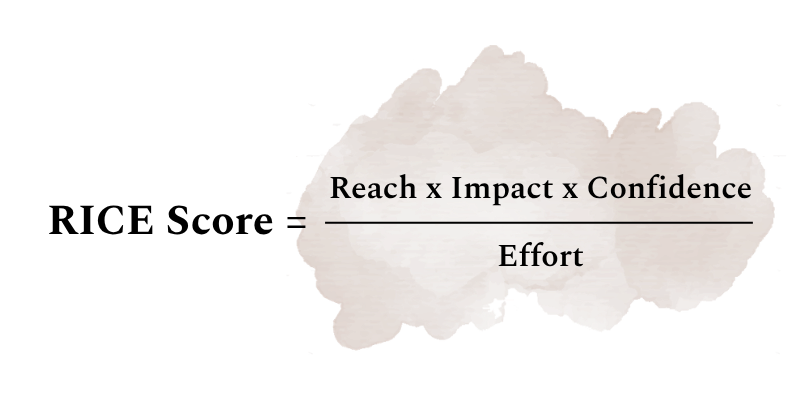
Let’s imagine you’ve estimated the following scores for your to-do list, using the number of people you expect to reach over the next week and the hours each task will take.
| Task | Reach | Impact | Confidence | Effort | RICE Score |
|---|---|---|---|---|---|
| Send email with new offer | 500 | 2 | 80% | 2 hrs | 400 |
| Cold outreach to event leads | 50 | 3 | 90% | 3 hrs | 45 |
| Plan and post social content | 300 | 0.5 | 60% | 4 hrs | 22.5 |
| Update website messaging | 100 | 2 | 70% | 8 hrs | 17.5 |
| Order printer supplies | 2 | 0.25 | 100% | 0.5 hrs | 1 |
*Illustrative scores only. Actual estimates should reflect your business, available evidence and objectives.
Based on these scores, sending the email to your existing database would be your highest priority. It has the potential to reach a relatively large number of people, directly supports your sales objectives and requires comparatively little time to complete.
The cold outreach comes next. Although it reaches fewer people, they’re leads you’ve already met at an event, so there’s potentially a stronger opportunity to turn those conversations into new business.
However, there’s something worth considering before you start working through your newly prioritised list.
The email campaign might score highest because it reaches more people with relatively little effort. But what happens if the website you’re sending those people to has unclear messaging or a poor conversion rate?
In that situation, improving your website might actually be the more sensible place to start, even though it scored considerably lower. After all, there’s little value in driving more people to your website if they’re struggling to understand what you offer or why they should choose your business.
This is where the RICE framework has its limitations. The scoring system evaluates individual activities, but it doesn’t necessarily account for how those activities influence or depend on one another.
There’s also the question of commercial value. An activity that reaches 500 people might score considerably higher than one that reaches just 50, even if those 50 people are much more likely to become paying customers. Similarly, longer-term improvements, such as refining your positioning or improving your website’s conversion rate, can appear less attractive because they require more effort upfront.
That’s why RICE is most useful when you’re comparing activities against a common objective, using consistent assumptions and a sensible timeframe. It’s also important to consider the quality of the opportunities you’re evaluating, rather than relying entirely on the numbers.
Ultimately, the RICE framework should help inform your priorities, rather than make decisions on your behalf.
It won’t replace strategic thinking, but it can provide a useful starting point when you’re faced with competing priorities and limited time or resources. The real value comes from combining that structure with an understanding of your business, your customers and what will genuinely contribute to growth.
There’s no single framework that’s right for every business. The most appropriate approach depends on what you’re trying to understand or improve. Based on the handful we’ve shared with you today, here’s a quick guide to understand when they’re best used for your business…
| Framework | Best used for |
|---|---|
| SWOT | Understanding your market position and identifying opportunities or risks |
| SOSTAC | Developing and managing a comprehensive marketing plan |
| RACE | Reviewing the customer journey and improving marketing performance |
| RICE | Prioritising individual activities based on potential value and effort |

When does your business actually need a marketing framework?
There’s no particular business size, revenue threshold or team structure that determines when you need a marketing framework.
A small business with a straightforward offering might manage perfectly well with a relatively simple approach. Meanwhile, an established business with several departments, multiple customer groups and a substantial marketing budget may need something considerably more structured.
The question is whether your existing approach is helping you make effective decisions. That’s the crux of the matter.
However, from our experience, there are a few situations where introducing a framework becomes particularly valuable.
When your marketing activity is growing faster than your results
Perhaps you’re investing in more channels, producing more content or spending more on advertising, but revenue isn’t increasing at the same rate.
A framework can help you examine how those activities contribute to the customer journey and whether your investment is focused on the right opportunities.
When different teams have competing priorities
As businesses expand, marketing often becomes responsible for supporting multiple departments, products and commercial objectives.
Without an agreed structure for prioritisation, marketing teams can find themselves responding to requests rather than working towards a shared goal.
A framework helps establish a consistent basis for evaluating opportunities and deciding where resources should go.
When you’re preparing for your next stage of growth
Entering a new market, launching additional services or targeting a different customer segment can significantly change what your marketing needs to achieve.
A strategic marketing framework can help assess those opportunities before committing significant time and budget.
When you have marketing data but aren’t sure what to do with it
Many businesses have access to more marketing data than ever before, from website analytics and advertising platforms to CRM systems and sales reports. But having access to that information doesn’t automatically make it easier to decide what to do next.
A marketing framework can help businesses establish which measures are relevant to their objectives and how those insights should influence future decisions. This becomes particularly important when different channels appear to be performing well individually, but their contribution to wider business growth isn’t clear.
How to choose the right marketing strategy framework
Before choosing a marketing framework, it’s worth understanding what problem you’re trying to solve.
If your business is struggling to understand its market position, a SWOT analysis might provide a useful starting point. If your marketing channels aren’t working together effectively, a customer journey framework such as RACE could help identify gaps.
For a business looking to develop a comprehensive marketing strategy, SOSTAC may offer a broader planning structure.
You can also combine elements from different frameworks where appropriate.
What matters is that the approach reflects your business, your resources and the decisions you need to make.
A framework should also be flexible enough to evolve. Customer behaviour changes, competitors adapt and business priorities shift. Regular reviews help ensure your marketing remains relevant rather than becoming tied to decisions made months or years earlier.

A marketing framework is only useful if it influences decisions
One of the biggest mistakes we see businesses make is treating the creation of a marketing framework as the finished piece of work.
A beautifully presented strategy document might look impressive, but its value is limited if it doesn’t influence how marketing is planned, delivered and measured.
At The Business Tea, we believe the starting point should always be understanding the business itself. What are you trying to achieve? Where are your opportunities? What’s currently preventing you from making progress?
From there, the right structure can help turn those insights into decisions and practical action.
If your business has reached a point where marketing decisions are becoming harder to make, or you’re investing in activity without a clear understanding of what’s contributing to growth, it might be worth reviewing how your marketing is planned and prioritised.
At The Business Tea, we work with growing and established businesses to understand their challenges, identify opportunities and develop marketing strategies that can actually be put into practice.
If you’d like a fresh perspective on where your marketing should be focusing, explore our marketing strategy and consultancy services.
Frequently Asked Questions
What is the purpose of a marketing framework?
The purpose of a marketing framework is to help businesses make more structured and informed marketing decisions. It provides a consistent way to assess opportunities, establish priorities, plan activities and evaluate performance.
For growing businesses, a marketing framework can be particularly useful when managing multiple marketing channels, competing priorities or increasing budgets. It helps ensure marketing decisions are considered in the context of wider business objectives.
What is the difference between a marketing framework and a marketing strategy?
A marketing framework provides the structure used to develop and evaluate marketing decisions, while a marketing strategy defines the direction your business intends to take.
For example, a business might use the SOSTAC framework to develop a marketing strategy focused on attracting higher-value customers. The framework guides the planning process, while the strategy establishes the target audience, positioning, priorities and intended outcomes.
What are the most common marketing frameworks?
Some widely used marketing frameworks include SWOT analysis, SOSTAC and RACE. Each serves a different purpose.
SWOT helps businesses understand their market position, SOSTAC provides a structure for marketing planning, and RACE focuses on the customer journey and marketing performance.
Other frameworks, such as RICE, can support marketing decisions by helping teams prioritise activities according to their potential impact and the resources required.
What is the best marketing strategy framework for a small business?
The best marketing strategy framework for a small business depends on its objectives, available resources and the challenges it’s facing.
For a business developing its first structured marketing strategy, SOSTAC can provide a useful starting point. A SWOT analysis might be more appropriate when exploring new markets or assessing competitors.
Smaller businesses don’t necessarily need complicated frameworks. The important thing is choosing an approach that helps them make better decisions and can realistically be maintained.
When should a business introduce a marketing framework?
A business may benefit from introducing a marketing framework when its marketing activity becomes difficult to prioritise, performance is unclear or different teams are working towards competing objectives.
Frameworks can also be valuable during periods of growth, particularly when entering new markets, expanding services or increasing marketing investment.
There’s no particular revenue threshold or business size that determines when a framework becomes necessary. The decision should reflect the complexity of your marketing and the challenges you’re trying to address.
Can you use more than one marketing framework?
Yes, businesses can use multiple marketing frameworks together, particularly when they address different challenges.
For example, a business might use SWOT to assess its market position, SOSTAC to develop its marketing plan and RACE to review how effectively its marketing supports the customer journey.
The key is ensuring each framework serves a clear purpose. Introducing several frameworks without understanding what they’re helping you achieve can create unnecessary complexity.
How do you measure whether a marketing framework is working?
The effectiveness of a marketing framework should be assessed by how well it supports decisions and contributes to business objectives.
Depending on your strategy, relevant measures might include qualified leads, customer acquisition costs, conversion rates, revenue growth or customer retention.
It’s also worth considering whether the framework has improved how your team prioritises work, allocates resources and responds to changes in performance.
A framework might be well documented and consistently followed, but if it isn’t helping the business make better decisions, it may need reviewing.
Do you need a marketing consultant to develop a marketing framework?
Not necessarily. Many businesses can introduce established marketing frameworks themselves, particularly when their objectives are straightforward and they have the expertise and time available internally.
However, external marketing support can be valuable when you’re dealing with competing priorities, limited internal resources or uncertainty about where your marketing investment should be focused.
An experienced marketing consultant can bring an independent perspective, help identify opportunities that might otherwise be overlooked and support the development of a strategy that can be implemented in practice.